Thursday, June 17, 2010

The Asteroid

"Asteroid", what a name for an insect! (So named for one of its food plants, the aster).
They are also called the "Goldenrod Hooded Owlet Moth" (For their other favorite food).
I found a few of these caterpillars while sweeping some wild grassy areas along the side of the road. Small, bright green with yellow and black stripes, they are rather striking when you look up close.
I caught a photo of this one while it was cleaning itself.

I would like to take this opportunity to promote my graduate adviser's book - The Caterpillars of Eastern North America. If you are interested in identifying caterpillars, this is for you! I'd consider it an essential addition to any field guide collection. As any naturalist knows, caterpillars are usually overlooked in butterfly/moth guides. And if caterpillars are shown, they are usually an afterthought for the more showy species. Having a focus on caterpillars and their anatomy and variations is essential. This book has served me quite well so far this summer.

Wednesday, June 16, 2010

Pupa update

Two days ago I posted pictures of a couple small pupae I had found in some rolled leaves. Today, one of them emerged. It was, in fact, the one with the pointy head. Not surprisingly, this moth has a somewhat pointy head.

It also has two curious black fuzzy bumps on its back, and beautiful green eyes.

It flew off as I was taking photos (hence the photo in the pine tree), and I eventually lost track of it.

From the shape of the wings while at rest, my first guess for family is Tortricidae.

I think I might have the ID, Olethreutes connectum, based on this site. Let me know if you think I'm right!

Not a caterpillar

I was looking for caterpillars yesterday, using my sweep net to sample some tall grasses along the side of the road. I threw this guy into my jar, and it wasn't until I took it out for a photo that I realized it wasn't a caterpillar at all!
- Eyes. Caterpillars have six small eyespots on each side of the head, while this creature has only one.
- Pro-legs. Caterpillars have up to four pairs of prolegs (the fleshy legs along the body, *not* including the front three pairs of true legs with claws). This creature has 7 pairs that I can see, including the back end.
- Behavior. Whenever it is touched by anything, it thrashes around wildly.

It could only be one thing - a sawfly larvae!
Sawflies are in the order Hymenoptera along with the ants, bees, and wasps. There are several sawfly families - I'm not yet sure which family this larvae belongs to.

St. Croix - Fish

Of course, we saw hundreds of different fish species while snorkeling. Here I will highlight a few of my favorites.

First up, on the left, is a fish I had never seen in the wild before. Sadly the photo did not turn out too sharp, but you can still see the shape of the longlure frogfish (Antennarius multiocellatus). It is bright yellow and lumpy in order to blend in with the sponges - though individuals of this species come in a variety of colors. It was incredibly cute, and as I touched it, it only reluctantly moved. In fact it then tried to wedge itself between some sponges, spreading out its strange fleshy fins as leverage. It was found at Fredericksted pier.

On the right is a juvenile french angelfish. It is an old juvenile, as it appeared about 10" long - I have not yet seen a fully grown adult french angelfish with no stripes. The young ones are still impressive, though, as they flit between the schools of smaller fish. We usually see these at the tires, which were sunk out in the bay in front of the condo next door to ours.

We came across several large schools of fish at the Vincent Mason resort and Fredericksted pier. I'm still not sure what species they were, but they had beautiful green stripes. It felt like we were in the middle of an underwater documentary, there were so many thousands (millions?) of fish! They moved in the most amazing patterns, and as I swam and dove among them, I never once felt one brush up against me.

St. Croix - Stingrays

If there is one group I get excited about seeing while snorkeling around St. Croix, it is the stingrays. I have seen both southern stingrays (Dasyatis americana) and spotted eagle rays (Aetobatus narinari), though a few other species do live around the island.

The southern stingrays are usually sedentary, seen lounging on the sea floor. They are either in plain sight, or partly buried in the sand. This is not much of a disguise for a snorkeler who knows what shapes in the sand to look for. Sometimes you can also spot them while they are feeding - you will first see a plume of sand in the distance, and as you approach, the stingray will be concave over the sand, trying to suck up some prey.
When you swim close, they generally are not too perturbed. I do not try to touch wild stingrays - while unlikely, I don't want to risk getting stung. Also, I don't want to spook them too much, I'd rather get to watch them and take some photos. This little stingray had a wingspan of only about one foot, and started turning around as I dove down to take a photo. The sea floor was too deep for me to stay more than a few seconds, though, and he slowly swam away as I surfaced. My friend and I followed him for a while before some fish caught our eye.

The spotted eagle rays are a bit more elusory - never sitting still, they fly through the shadows. I don't always see them, even after week long trips of snorkeling at various beaches. This trip, at Fredericksted pier, we saw two large eagle rays float between the posts. They did not alter their speed or their course, even as the three of us swam toward them. It was a surreal moment.

Tuesday, June 15, 2010

St. Croix - Puffed

Some of my favorite creatures to encounter while snorkeling are the porcupine fish and the balloon fish (both in the Diodon genus). Of course, we have to try to puff them up. I know this is aggravating to the fish... but it usually does not take much. Just poking them gently (wearing gloves!) or trying to grab hold of them will cause them to puff up. Some are more difficult to go after than others, though, and are able to out-swim us. It's usually the little ones we can get our hands on. We also limit our time with the fish, and let them deflate/swim away after a few quick photos.
(this is me)
I love getting to see natural behaviors, especially defense behaviors, in the wild. This is one I feel quite privileged to witness, being able to swim where they live and get a close up look at how they work. Nothing beats feeling a spine going through your glove in order to learn how sharp a porcupine fish spine is.

For those that know me, getting hands on with nature is a must... I don't understand how anyone can go snorkeling without gloves on.

Cute little leps

Yesterday I posted about some eggs I had found... well, I also found a few caterpillars and pupae.

This one I believe to be (Nadata gibbosa), the white-dotted prominent. It's an early instar, as the head is still large proportional to the body, and a full grown caterpillar gets to be up to 5cm long. I have other photos that better show the markings, but I thought this was a fun shot. I will be raising it to see if I'm right.

I would greatly appreciated help identifying these two pupae. They were both found in rolled leaves (I have yet to identify the host plants, working on that). Very small, about 1cm long. Definitely alive and wiggling. The one on the right has an unusually pointy head, and rather small wings compared to the body size.

Monday, June 14, 2010

An entomological day

Taking a quick break from St. Croix posts to look at some of the neat things I found in my backyard today - eggs.

First up, the one I'm most excited about - a Polyphemus moth egg (Antheraea polyphemus). It's rather large, rather flattened shape, about 2mm across, white on top and brown around the edges.

I found it on the underside of an oak leaf. I proceeded to search as much of the small tree as I could reach, with the aid of a chair... could not find any others. In this post I show pictures of an adult Polyphemus moth. I have never seen their caterpillar in the wild, so I'm really hoping this one hatches. Even if it doesn't, or if the caterpillar does not survive, I'm happy to have found an egg.

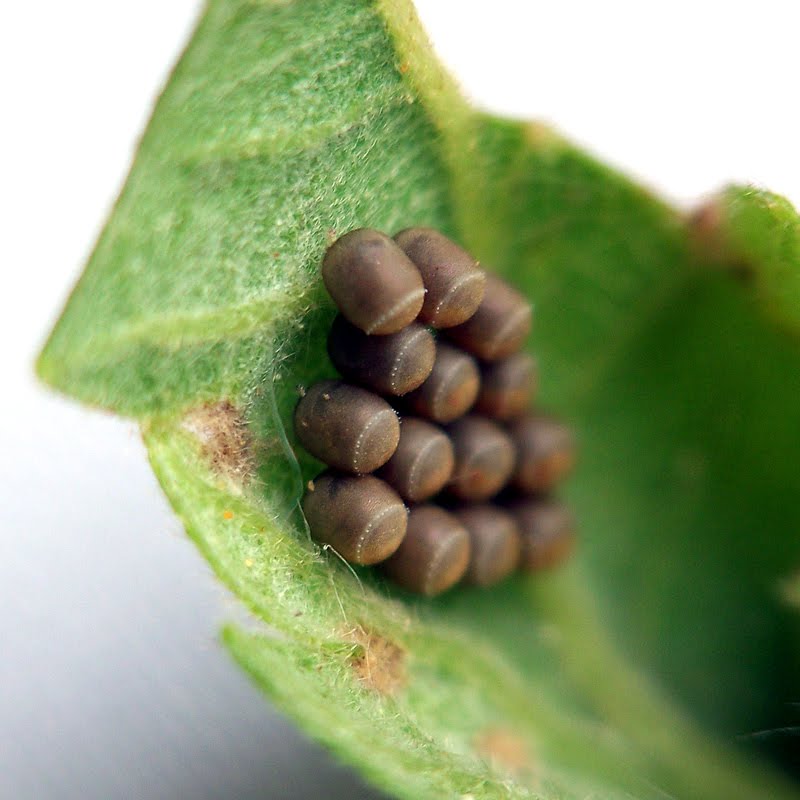
I also encountered the eggs of a few members of Pentatomidae - the stink bugs and shield bugs.

I believe the eggs on the right belong to the spined soldier bug (Podisus maculiventris). They were found on our quince tree. The eggs on the left were found on an oak tree.

On several of the oak leaves I examined, I saw bunches of very small eggs. Well, without any visual aids, I could only guess they were eggs, as to my eyes they were barely a bunch of little black spots.

Finally, I found a bunch with a lace bug (Tingidae) sitting guard nearby. Lace bugs are beautiful, and very small, only a few mm long. I took a few photos, and yup, they were eggs alright!

I was not sure if this was a coincidence or not, but sure enough, I saw a few more egg clusters with an adult lace bug nearby.

Lace bugs can be plant pests, but I'm debating whether I'd want to try raising a few. Could be fun.

St. Croix - Birds

Going to a Caribbean island, you'd expect to see and hear tropical birds - beautiful and unusual sounds, bright and showy feathers... but not quite so on St. Croix.

First of all, as far as domesticated birds, chickens run loose through the streets, neighborhoods, and even downtown Christiansted. Waking up to the sound of gently lapping waves and a rooster is an interesting experience.

One of the first birds we are greeted with, and accompanied by on the beaches, is the Zenaida dove (Zenaida aurita). It sounds just like the mourning doves we have back home, which has a rather eerie call. June appears to be their mating season, as the males were calling incessently while chasing females around the beach.

There are several other dove and pigeon species on the island, including the well known Rock Pigeon (Columba livia).

There is one bird that did make some very pretty sounds around our condo, but we could not locate the source. Finally, we tracked down a rather bland looking bird, but he sure had a beautiful voice! It was the pearly-eyed thrasher (Margarops fuscatus).

A family of American kestrels (Falco sparverius) also decided to make their home near the condo complex. The babies looked to be nearly full grown size, and did not sit in a nest but on tree branches. They could fly, but were however still very fluffy, and cried for food nearly all day long.

We once got to see one of the parents with a lizard in its beak, which was fed to one of the babies.

One of the cutest little birds on St. Croix is the Bananaquit (Coereba flaveola), which I unfortunately could not get a clear photo of. It is a revered bird on the island, the muse of many local artisans. Its bright yellow belly and black bandit's mask make it an amusing character.

Next visit I hope to spend more time in the mangrove forests, which harbor many more interesting bird species.
Sunday, June 13, 2010

St. Croix - Crab Races


In my last post, I mentioned the hermit crabs of St. Croix. They are not only interesting wildlife, but can be used for entertainment. This is a tradition dating back centuries, which has seen a resurgence of interest in some places. My family has gone to the hermit crab races since we started visiting the island in 2001.

Tito and Sue are a husband and wife team who have been organizing hermit crab races on St. Croix for almost 20 years. They go to several different venues each week, usually bars and restaurants, where they can draw some chalk circles on the floor. For $2 you can choose and name a crab; the name is written on a piece of tape on its shell. Our family tends to use many of the same names each time, such as "Crusher", "Grave digger", and "Widow maker". Many local businesses donate prizes such as boat trips, island tours, and bottles of rum.

For each race, the crabs are placed underneath buckets in the center circle. After a kazoo start and the cry of "CHARGE!", the crabs are released, which then mosey on towards the finish line.

There are some very important rules, which are: "Don't point your fingers, don't stomp your feet!", as these can scare the crabs. Tito always brings a roll of tape, and will tape up anyone's hands if they start pointing. The culprits are almost always adults, the children are quite well behaved. One man got completely taped to a pole!

More after the jump